The Cursed Kings
This article was published before 2022, therefore before the rise of generative AI. Some information may now be outdated. The period drawings and visuals shown here were created without the assistance of artificial intelligence.
Recently, I finished a particularly fascinating book series to read: The Cursed Kings.
What is it?
It is a literary saga that enjoyed phenomenal success at the time of its release, and which earned its author, Maurice Druon (incidentally, nephew of Joseph Kessel), a genuine popular following, in addition to numerous official awards (Grand Cross of the Legion of Honour, Commander of Arts and Letters, Medal of Free France, etc.). He is also known for having helped write the lyrics of the Song of the Partisans. This should not make us forget, however, some controversial stirrings concerning the man, before he disappeared…
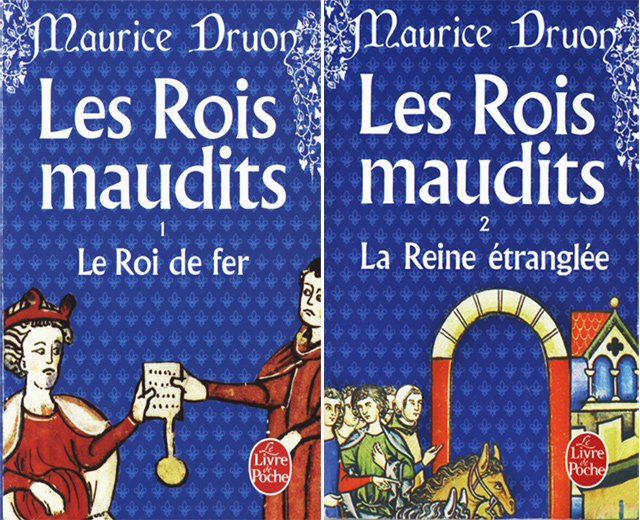
The cursed king – cover – in french.
The Iron King spans the reign of Philip the Fair, The Strangled Queen recounts the early reign of Louis X, his eldest son, whose wife from his first marriage will be strangled.
The plot
Published between 1955 and 1977, adapted twice into a TV film (1972 and 2005), this saga comprises 7 volumes. It tells the story of the fall of the French Capetian royal branch, from King Philip the Fair, then of his descendants and further descendants. Cursed kings, because it truly is a curse. The first volume starts off strongly, with the description of the torment of the most powerful Templars, condemned to the stake by Philip the Fair. In the violence of their burning, they then cast a curse upon the reign of the “Iron King” and his descendants. Coincidence or not, his 4 children (3 sons and 1 daughter) will succeed one another on royal thrones, but will fail to ensure the continuity of their direct dynasty, whether in France or in England, thereby bringing about the fall of the direct Capetian dynasty. And it is this same crisis that will lead to the terrible Hundred Years’ War, whose seventh and final volume recounts the painful beginnings for the Valois dynasty.
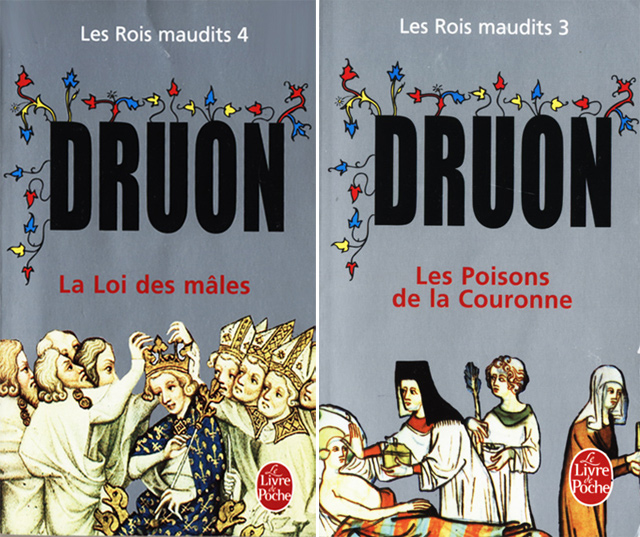
Volume 3 & 4
Volume 3, the Law of Males, tells of the end of the reign of Louis X, who dies without descendants. Volume 4 recounts his succession by Philip V the Tall, somewhat bumpy…
The 7 books:
- The Iron King
- The Strangled Queen
- The Poisonings of the Crown
- The Law of Males
- The She-Wolf of France
- The Lily and the Lion
- When a King Loses France
Two different styles of writing
Although all the books fit into the same logical continuity, they do not convey it in the same way at all. In fact, the last one is clearly different from the first six, which can be unsettling when you get to it. Different, because the first six have as their common thread the wanderings of Count Robert III of Artois. He is a schemer, litigious, manipulative, who uses every means to recover his County of Artois at the expense of his aunt Mahaut. This court intrigue is interwoven with a multitude of others. As for the seventh book, we simply follow the cleric Hélie of Périgord, who tries to negotiate with the King of France, and who recounts the events, in the first person, of the early period of the Hundred Years’ War. This stands in radical contrast to the tone of the other books.
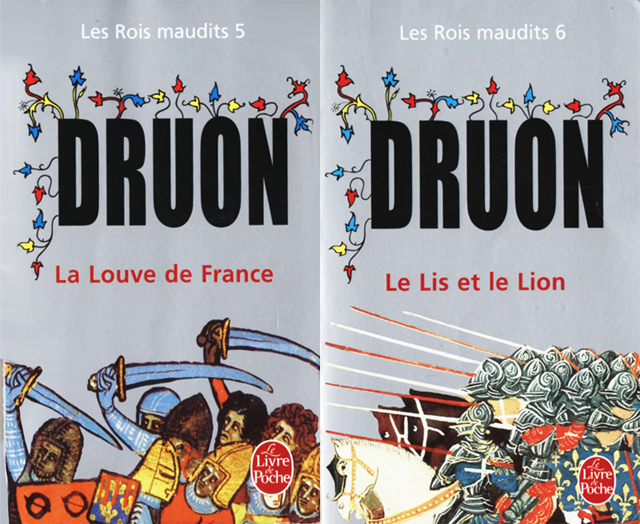
Book cover 5 & 6
The She-Wolf of France, volume 5, recounts the reign of Philip the Fair’s last surviving son, Charles IV. His sister, Queen of England, will overthrow her husband’s English power. The “Lily and the Lion” sees the end of Charles IV’s reign… and the beginnings of the Hundred Years’ War.
Why I really got hooked, and why you might too!
At a time when series such as Game of Thrones, Rome, The Tudors, Spartacus, The Borgias, or even Merlin are hugely successful thanks to a form of realistic, historical violence, it is good to remember that sometimes, nothing beats the original: history with a capital H! And that is what this series of perfectly written books shows us, books that have not aged a day. Here, in France itself, at the very heart of power, men and women fought, for just or unjust causes, always tied to personal interests, sometimes themselves entangled with even broader interests; with selfishness and harshness, which makes them… terribly human. It is therefore brilliantly that this novel once again demonstrates that small stories make the big ones. No ingredients typical of the best historical epics are missing. Love, passion, betrayal, adultery, envy and jealousy… With the slight detail that in those days, betrayals cost lives, interrogations were torture, and poisonings and diseases caused the bewilderment of a credulous and terrified court. And it is because reality far exceeds fiction, and because it is not dressed up in Hollywood studios, that it carries the reader away into a fascinating sweeping novel where the abundance of detail is truly incredible and numerous, the fruit of a mind-blowing amount of research. All the notable protagonists really existed, and all the deeds recounted — from matters of morals to major capital executions — did indeed take place. Where the author perfectly played his role was in his ability to elevate reality through his personal reinterpretation of the psychology of these historical figures. He revisits them in his own way by imagining the most intimate and emotional reactions of the greatest monarchs of the Western world, with great precision and finesse, which completes a perfectly realistic canvas. For the rulers of today could perfectly be identical in these roles; you are hooked with conviction. So there are indeed additions and interpretations, beginning with the so-called Templar curse, which has no historical basis. But one will savor these additions all the more, a perfect simulator of our own imagination as readers! For not only do these additions merely fill in information that does not exist anyway, but also because this creative puzzle is ultimately simply remarkable for its coherence and realism.
Learning while having fun.
The impression after such a read is that a real film unfolded before our eyes, with the slight detail that everything could very well have happened as described. And it is with this tangible reality in mind that one begins to rediscover, with very keen interest, whole sections of the history of the Kingdom of France. I insist on this impression of realism, because I am generally quite resistant to fantasy.
Uneven film adaptations.
Adapting this kind of realistic book into a film or TV movie must be no easy feat. And yet French television tried it twice: in 1972, which made Jean Piat famous in the role of Robert of Artois, and once again in 2006. Both adaptations are currently viewable on YouTube:
The 1972 production:
The same volume, but from the 2005 production (partially available):
Without having seen more than the first episode of each adaptation, I have criticisms and advantages for both:
– For the 1972 version, the drawbacks: too theatrical, little if any outdoor scenes, one feels a bit stifled by the scenes and framing, whereas this is an epic. The characters speak to the camera. In short, we are still dealing with the codes of 1970s French cinema, stuck in the codes of French comedy even though this is cinema. The plus:
No unnecessary flashiness, and everything rests on particularly charismatic key actors, who match the descriptions in the books. Jean Piat as Robert of Artois is unrivaled there. The classic theatrical performance, it must be acknowledged, gives the characters prestige.
– For the 2006 version: Philippe Torreton, a very good actor all the same, must play a calculating and deceitful giant; he cannot compete with Jean Piat. The same goes for Mahaut, despite, here too, the very talented Jeanne Moreau, with a distinctive voice and a character that does fit. Mahaut is a giant, that is all! And the Iron King is better too in the 1972 version, ultimately more faithful to the book’s descriptions. The strengths, however, are the staging in more “natural” settings, and supporting actors who also stand out for the quality of their performances, such as Gérard Depardieu as a Templar knight, or Jean-Marie Winling as the perfect banker Tolomei Spinnelo. We also move away from this theatrical foundation toward a more subtle and realistic acting style. On the other hand, perhaps hampered by sound effects that are still very much in fashion today, but which will certainly be “has-been” in ten years…
Granted, these are easy criticisms when you have read a book and formed your own idea of the characters, but it gives you an idea of the power of the book’s hold!