The Court of the Red Tsar!
This article was published before 2022, therefore before the rise of generative AI. Some information may now be outdated. The period drawings and visuals shown here were created without the assistance of artificial intelligence.
Written by Simon Sebag Montefiore (British writer / historian specialized in the history of Russia), the biography of the dictator Stalin, “The Court of the Red Tsar”, the edition I browsed is spread over two “pocket” volumes (which have only the title), separating Stalin’s “reign” into two periods, from 1929 to 1941, and from 1941 to 1953.
The objects
The two books, a Tempus edition, are in fact one and the same book. The covers are photos that really strike the imagination; I found myself reading the descriptions on the back to know who was on them (apart from Stalin, obviously…). On the other hand, the publisher made a catastrophic choice by splitting it into two books, even if this is perfectly justified from a narrative point of view. Indeed, from the very first readings, pages detached from the spine of the book… On the other hand, the “pocket” format still allowed me to read it on the subway without difficulty. Perhaps “The Court of the Red Tsar” should have been divided into four volumes?
The writing
The writing is simple and accessible (it is a translation from English) and this huge documentary work brings out a wealth of anecdotes and details that one undoubtedly savors! The historian spent more than two years on it, and personally collected numerous testimonies from former members of the court. By the end of the book, one has the impression of having somewhat rubbed shoulders with Stalin in power, and one realizes the steel nerves it took to do it! You feel anxious along with the people around him!
The first part
When you begin the book, you come across an exhaustive list of Russian names that make up Stalin’s entourage; this list is categorized by affinities and roles. At first, it is very difficult to grasp, so do not focus on it, but do not hesitate to come back to it regularly afterward. Not being used to historians’ methodologies or those of avid readers, I made the mistake of reading it right away, which cost me time for little benefit, because the different protagonists are then described in greater depth in turn as they enter the story chronologically. You get hooked, because the prologue is the precise description of the evening when Nadia (Nadezhda in Russian), Stalin’s second wife, commits suicide. The description of the evening, the drama, and the context immediately immerses the reader in a palpable reality, and thus makes it all the more striking. It is this wealth of detail about events in Stalin’s life that gives this book its full power. Then, although this is not the book’s primary subject, the first part covers Stalin’s youth (starting with his birth, 1878) up to Nadia’s suicide, his second wife. Some witnesses would claim that it was this tragic event that completed Iossif’s transformation (Joseph in Georgian) into Stalin, that is to say into a relentless, cold, determined, and inflexible politician, giving free rein to all his murderous and paranoid excesses.
Iossif, Koba, Soso, Stalin.
I am not going to list here all the parts of these two books. Simply, as one would expect in a biography, they describe, in chronological order, Stalin’s evolution, roughly from the moment he is at the height of his power (1929, the anniversary of his 50th birthday), to the end of his life (the end of the second part), without omitting his childhood, since a broad overview is provided, as we have just seen.
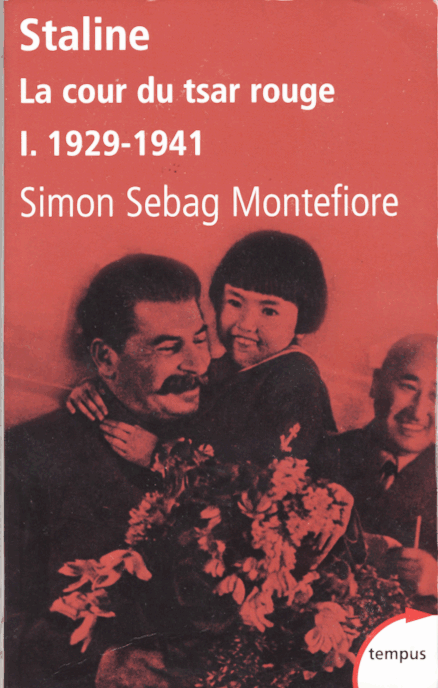
Cover of the first book. The little girl's parents were arrested and killed shortly afterward.
Questions first
When I tackled this book, I had simple questions (or even simplistic ones), put to the test by this biography. How can socialism, an idealism of collective happiness on paper, come to set up a system that will crush human lives and, in the end, will not even respect the idea of equality, with a character whose cult of personality will reach a higher point than ever? Where is a court worthy of the tsars put in place, where all abuses will be committed to the detriment of the very ideals they are supposed to embody? If these questions are not specific to Stalinism, we can draw others that are more specific to it; How can a Georgian come to be more fond of the Russian people than of the people he himself comes from? Who then is this hero of the Second World War who managed to defeat Nazism on the Eastern Front after concluding an alliance pact with them? Without answering them, since that is not its purpose either, this work provides solid elements of response.
The answers!
What follows will take up the elements of the book, which are generally found in all biographies, mixed with my personal analysis; coming from a poor background, overprotected by his mother (and at whose death he would not even go to the funeral…), Iossif Dzhugashvili became involved early in revolutionary movements, never to leave them again. He would suffer exile and imprisonment on several occasions, and even lead a life of banditry and robbery to enrich the cause. He would fight at Tsaritsyn (later renamed Stalingrad and finally Volgograd) against the White Armies, successfully, having under his command two military men who would outlive him, a notable fact if one considers the dictator’s purges…
With these few elements, one can already glimpse the monster that is taking shape; disdain for the elites, since he himself came from the people, and distrust pushed to its peak, caused by years of conspiracy, flight, and revolution. This point is worth emphasizing. How many dictators considered “mad” or “paranoid” came out of revolutionary movements? What situation is worse for the human mind than an underground movement? Permanent stress, being hunted, absolute distrust of everyone, including family members, the will to survive and to fight, the most basic survival instinct constantly activated, the promise of ideal tomorrows, the cult of secrecy… Obviously, being committed to “good causes” does not create serial killers alone, thank God; one must have other predispositions. Stalin had them. For example, a probable frustration, a constant fear of failure. Small in stature, his face pockmarked by smallpox, all his life he would be haunted by the fear of the failure of his policy, of Soviet ideology… He must be the leader, and he will tolerate contradiction less and less as his life goes on, as he eliminates his safeguards. The translation of this complex will be felt through a clear preference for people from humble backgrounds like him, or, better still, stubborn and fanatical autodidacts. He will build his new bourgeoisie, his nomenklatura, himself, which will in fact outlive him only in part… He forges strong ties (at least apparently) with people who have similarities with his past, his experience, or what he thinks he is; exiles, former seminarians (he was one himself), Georgians, revolutionaries, or writers (Stalin does not hesitate to rewrite poems, songs, or films according to his own wishes… and woe betide anyone if this is not respected!)… Finally, one last asset in the race for the Kremlin, and this may be surprising, Stalin knows how to charm those around him very well. Beyond that, Stalin displays a number of “talents” inherent to any politician, which can be considered classic in this milieu: a taste for intrigue, manipulation, a lack of scruples…
An ascent that unfolds smoothly
If this book has one merit, it is certainly that it contextualizes Stalin’s rise… among other brutes of the same kind! Stalin does not seem more bloodthirsty than others, at least at the beginning, and he takes care not to crush the other Bolshevik comrades, who are in fact mostly supporters. He uses his charm to the fullest to rally them all. Skillfully, he divides them and patiently works them over over time, never making a decision alone, always ensuring that he has allies… Following Nadia’s suicide, it is probable that he lost a strong attachment to human and social realities. Though hysterical, she had until then served as a safeguard and a link to a form of human and family reality. Certainly, the mass deportations of peasants, then the Holodomor, had already been put in place, and he is indeed its main driving force, but his destructive instinct had not yet struck his inner circle. Two years later, the assassination of the popular Kirov (1934), under very suspicious circumstances, serves as the trigger for all sorts of pressures in which he will go further and further… For the moment, he does not act entirely alone and is careful to keep one or two top officials he trusts informed. It is time for the great Moscow Trials! He will keep testing the loyalty of his henchmen, probing the reactions of those who remain. This is where we enter the full horror of his perverse game of power and control. Skillful games, in which he will taint his comrades one after another, leaving the blood of others on their own hands. Propaganda will of course support this scheme, always denouncing the internal enemy, never Stalin. In the background, the tragedy of entire peoples, deported and decimated in the name of the success of ideology.
Character traits that had to be encouraged…
This ideology, more puppet-like than concrete, haunted Stalin. His convictions occupied a prominent place in the early parts of his life, and he fought tenaciously for the Bolshevik cause. Although he had usurped Lenin’s succession, he nevertheless took up its principles and continuity, placing the socialist cause above all else. Those who do not respect this credo are seen as counter-revolutionaries, and therefore deserve… death. This binary and simplistic vision will be his creed, but one could argue that he was not the only one to have it. Unfortunately for many people, his convictions would evolve over time, and because of his desire to remain in power… Consequently dragging in their wake as many deaths as could be imagined, in clearly innocent trades or populations. Here too the book shows that this mechanism does not stem, far from it, from Stalin alone. His clique contains fanatics just as furious as he is; the cult of personality and the very word “Stalinism” were not invented by Stalin himself, but probably by one of his faithful lieutenants. Eager to shine in his eyes, simple opportunists, ideologues, or just cautious men wanting to save their skin, all had their own views on the actions to take, and tried to win his favor. He was in fact susceptible to influence, and knew how to listen to those who knew how to speak to him. And very often, when he hesitated, his political entourage was there to encourage and support him. Many evenings and movie screenings brought them together, and they were also a place for the exercise of power. During the shock of the Second World War, they would encourage him to stay in power, Stalin being doubtful and overwhelmed. The lives of potentates are thus punctuated by risky bets on the future choices of the leader. When Stalin decrees that this or that category of the population must be deported, it is indeed his subordinates who will carry out his orders as faithfully as possible! Out of conviction in the righteousness of their cause, and from a wish to look good, they will double or even triple the deportation quotas, which gives an idea of the massacres that will be committed indiscriminately… This desire to please, mixed with the latent threat of falling into disgrace, here is the ferocious mechanism that will feed on itself, nourished by Stalin and his faithful, with, as time goes on, fewer and fewer safeguards and relationships of trust. Which will produce a dictator increasingly… alone. This vicious circle is brilliantly and extensively described in the book.
An amusing propaganda video, with a cardboard actor who imitates the mannerisms of “Comrade Stalin”, in probably the most unhealthy way possible!! Stalin also did not like public performances at all
The man…
The task of any biography worthy of the name is to present to us not only the character but also and above all the man behind him, however unlikable he may be. Here again, a flawless success. Thus we discover a Stalin who loves his children and grandchildren, who visits his mother, who frees friends from the Gulag, who likes nothing more than gardening, likes to sing hymns, and very much likes cinema. In the evening, he does not dance much but likes to watch dignitaries do it, and he amuses himself with it. He likes nothing more than recounting the deeds of former deportees in Siberia. He very much appreciates the dachas in southern Russia, and likes to go for walks. We also see him downcast and doubtful (as I was able to describe him, for example, during the Second World War), but also cynical, liking to laugh at his victims, savoring their last moments. There is also this omnipresent paranoia, which will for example lead him in a grotesque way to relieve himself in front of his dignitaries, on a visit to the front, for fear of an ambush in the undergrowth…
This lucidity too, in scorning this cult of personality, which he deems necessary, but of which he takes care not to be duped. In his last days, in 1953, his aura of psychopath would work against him, since being paralyzed and dying for 2 days, the potentates would not dare to make a decision, instinctively fearing an imaginary recovery of the “vozhd”.
Conclusion
A work certainly dense, but which contains such a quantity of quotations and details that one never gets tired of reading it. This reality was far worse than many fictions, and that is probably what chills one most to the bone. Without exonerating Stalin for any of his crimes, it highlights the fanatics around him, completely dependent on his wishes and therefore less and less likely to bring him back to a tangible and human political reality. In short, a vicious circle created by his own hand, and of which he was probably not aware, and which made him lose touch with reality.