KP: The KorvusPad!
This article was published before 2022, therefore before the rise of generative AI. Some information may now be outdated. The period drawings and visuals shown here were created without the assistance of artificial intelligence.
Alas, how happy I would be if I had unlimited credits, and as many arms and brains to carry out all my desires, my creations, my folies !
I’m going to tell you about one of my ideas among others, but one that I turned into an image, just to share it more easily!
A new tablet?
As Microsoft has just released its new Surface tablet, with its clean and streamlined design, I was relatively impressed by the keyboard system.
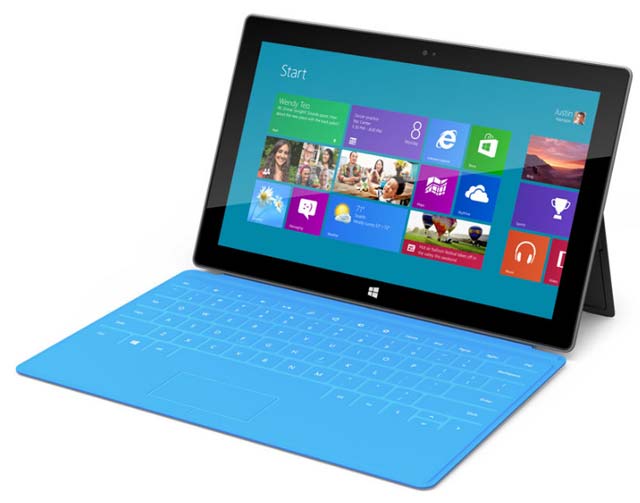
Surface, by Microsoft
A response to a real problem.
The keyboard-human interface is often problematic, and from personal experience, nothing is more comfortable than a physical keyboard for entering text.
Tablets also have advantages; the touch interface is very appealing, and the mobile aspect is very practical.
Going even further!
At the same time, Asus has released its Taichi dual-screen tablet (with Windows 8 also as the OS!); the screen has the particularity of being double-sided!
Here too, simultaneously, the keyboard and the screen are allied, while still keeping some room for maneuver in order to be able to use the screen alone. Personally, I see little point in having two screens simultaneously, but this is debatable.
Until now, the laptop therefore seemed to me the most appealing alternative, offering a physical keyboard at the same time as allowing mobility. But without the touch aspect that brings real comfort.
There are also solutions for ‘plugging in’ keyboards to existing tablets. That is true, but the tablet is not natively designed to meet this need, but rather to be consulted from the couch, without a solid surface to rest on. To that, the Taichi seems to respond.
Surface and Asus have managed to fill this gap. There is the comfort of the physical keyboard, and the touch screen. Where others did not dare venture, remaining on the dogmatic (therefore dangerous) “tablets are used from couches and beds”, they showed boldness, starting with Microsoft. And I would bet that this type of keyboard will quickly become essential.
Can we go further?
I was seduced by this approach, but there remained a “but”! I am used to large work surfaces, and dual screen is the rule at home. Let’s not forget that I am daydreaming, and that I am not thinking about launching a new product, but about satisfying my requirements!
So let’s continue “my” specification: I want a dual screen, but I also want to be mobile, and carry the minimum weight. I often travel between my workplace and home. We can therefore assume that I would have keyboards at home and also at my workplace, which means that the only thing to carry could turn out to be my screen, or, better yet, just my hard drive! Pool resources!
From there, my imagination started galloping.
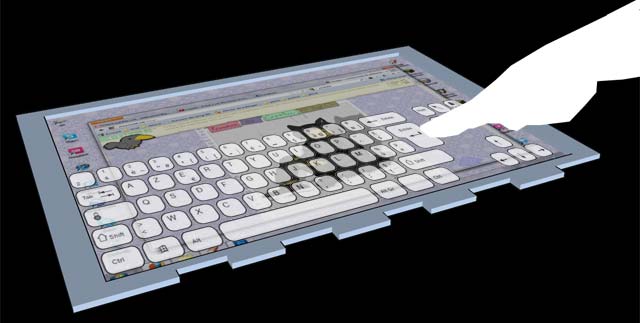
Let’s suppose a basic tablet…
This is a basic touch tablet. To type on the keyboard, I have to activate the dedicated function, as with current tablets. Now, let’s suppose I have the same tablet model safely at work.
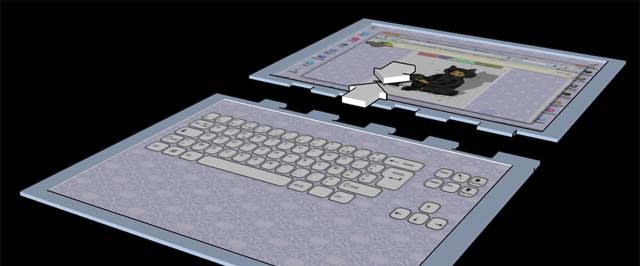
We clip the two tablets together
And boom, you’ve got a laptop!
So, of course, clipping two tablets together—that is where the difficulty would lie; how do you make them communicate, and how do you make them hold together? That is THE complicated engineering problem for this scenario, but one that I think could be solved. Even if we start from the principle that there could be a wireless connection, and that the clipping system would be purely mechanical in function.
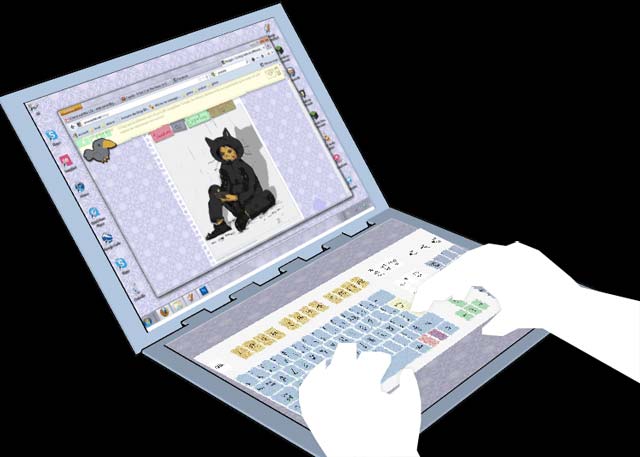
and boom, you’ve got a laptop
Now I can hear you coming! But what happened to your wish for a physical keyboard? True, I removed it from my specification; but we are nevertheless returning to a “keyboard-screen” logic, from which I have trouble parting, for example when writing or coding!
Now, even better, let’s suppose that a colleague is absent today (but that I have his password 😉 )!
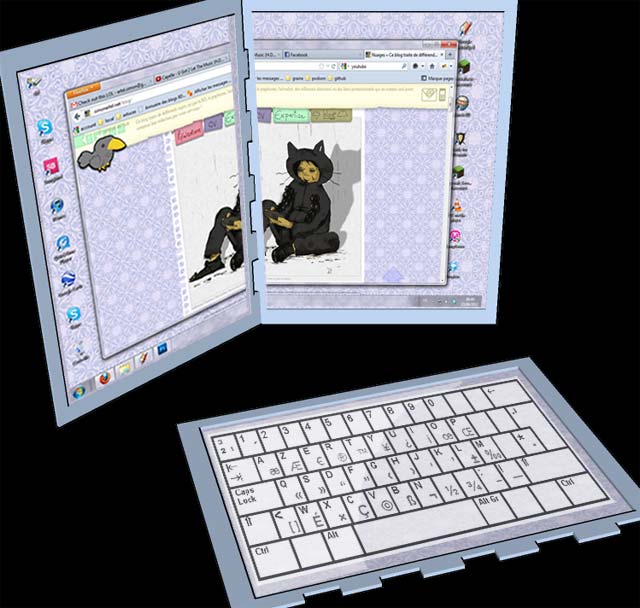
dual screen !
And there you have it, you can end up with a cheap dual screen easily! In fact, the logic is moving closer to elements that are increasingly pluripotent, independently functional, but capable of forming a more complex logic when put together; in short, Lego bricks!
But… the keyboard?
Yes, the physical keyboard is a real missing feature, and I would be the first to complain about it.
An infinite variety of possible avenues exists:
– Recent technological solutions manage to electrically modulate the sense of touch, an extremely powerful potential that could meet this need.
– A plastic layer, like the ‘surface’ or certain existing keyboard overlays, which could be placed over the screen and serve as a keyboard.
– Finally, a far-fetched solution would be to place a keyboard behind the screen, a double-sided pad therefore. To protect it during transport, it would be enough to add a case system.
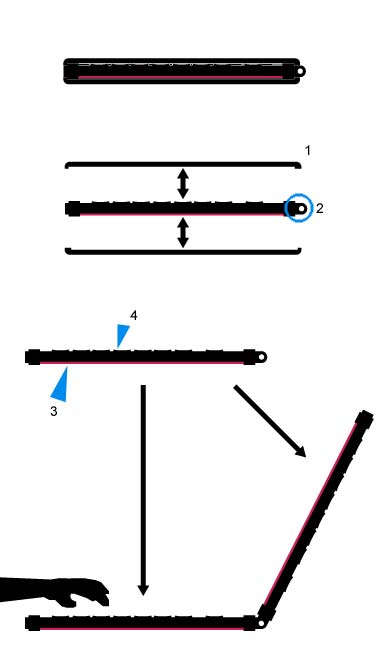
Computer of the future. Or not.
Now all that remains is to see what the future will bring us 🙂